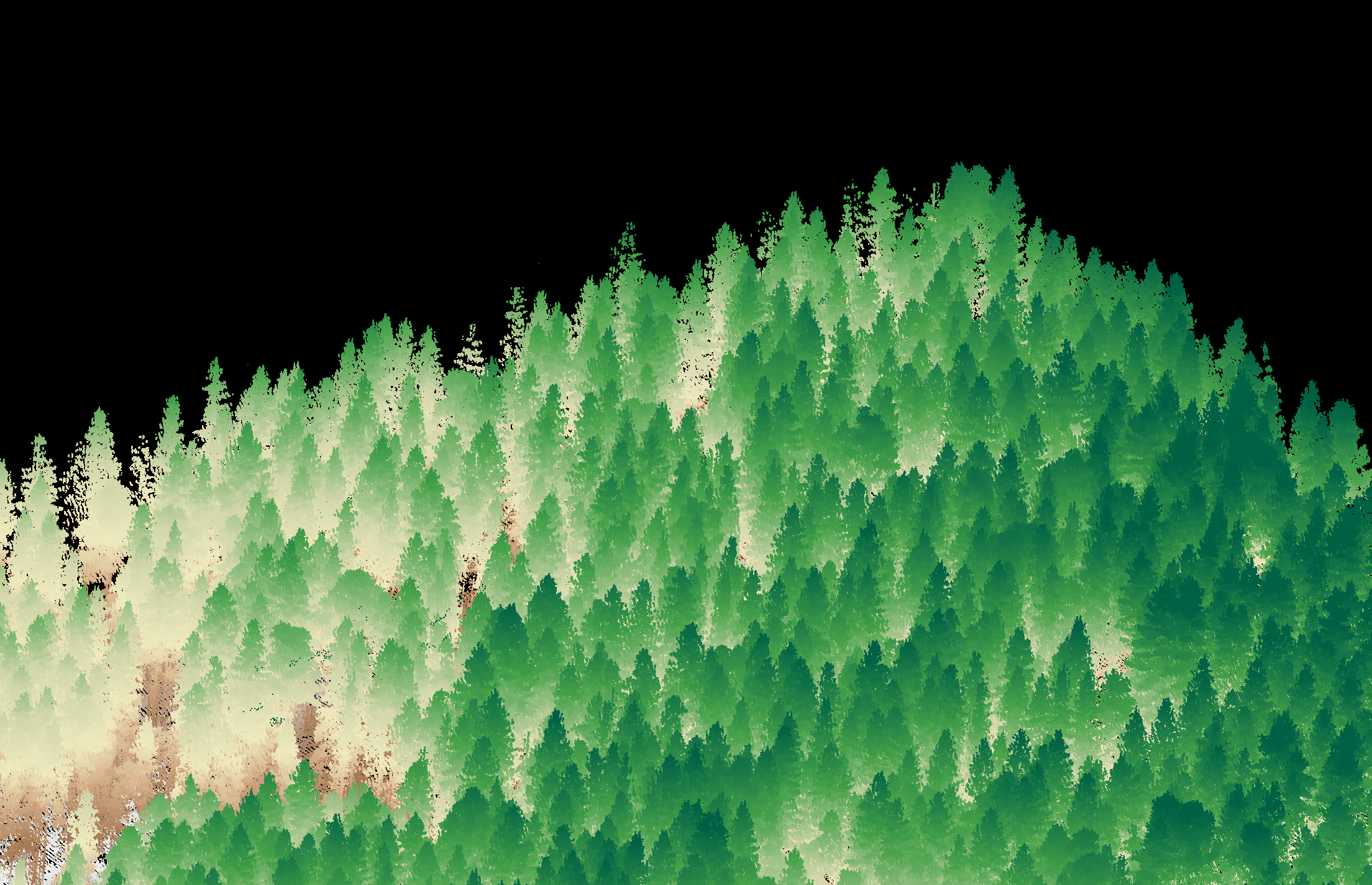




We investigate two pretraining strategies for a common LitePT backbone — self-supervised and supervised — and transfer each to downstream forestry tasks via frozen features or fine-tuning, compared against training from scratch. This unified protocol enables a systematic comparison of representation learning strategies under identical transfer conditions and annotation budgets.
The student encodes masked, partial views of a forest point cloud; the teacher encodes the same scene in full. Two prediction heads align the student's representations with the momentum-updated teacher's — with no labels and no negative pairs.
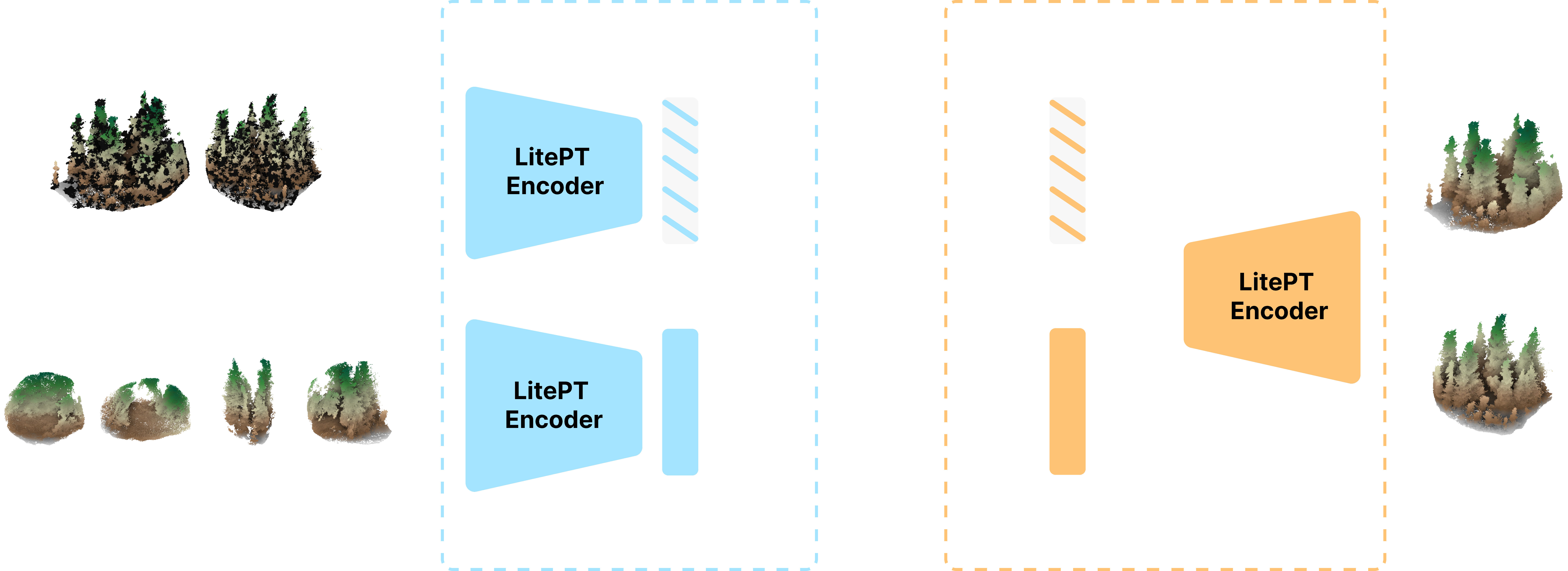
Per-point features from our frozen self-supervised backbone, projected to RGB via the top-3 principal components (PCA).
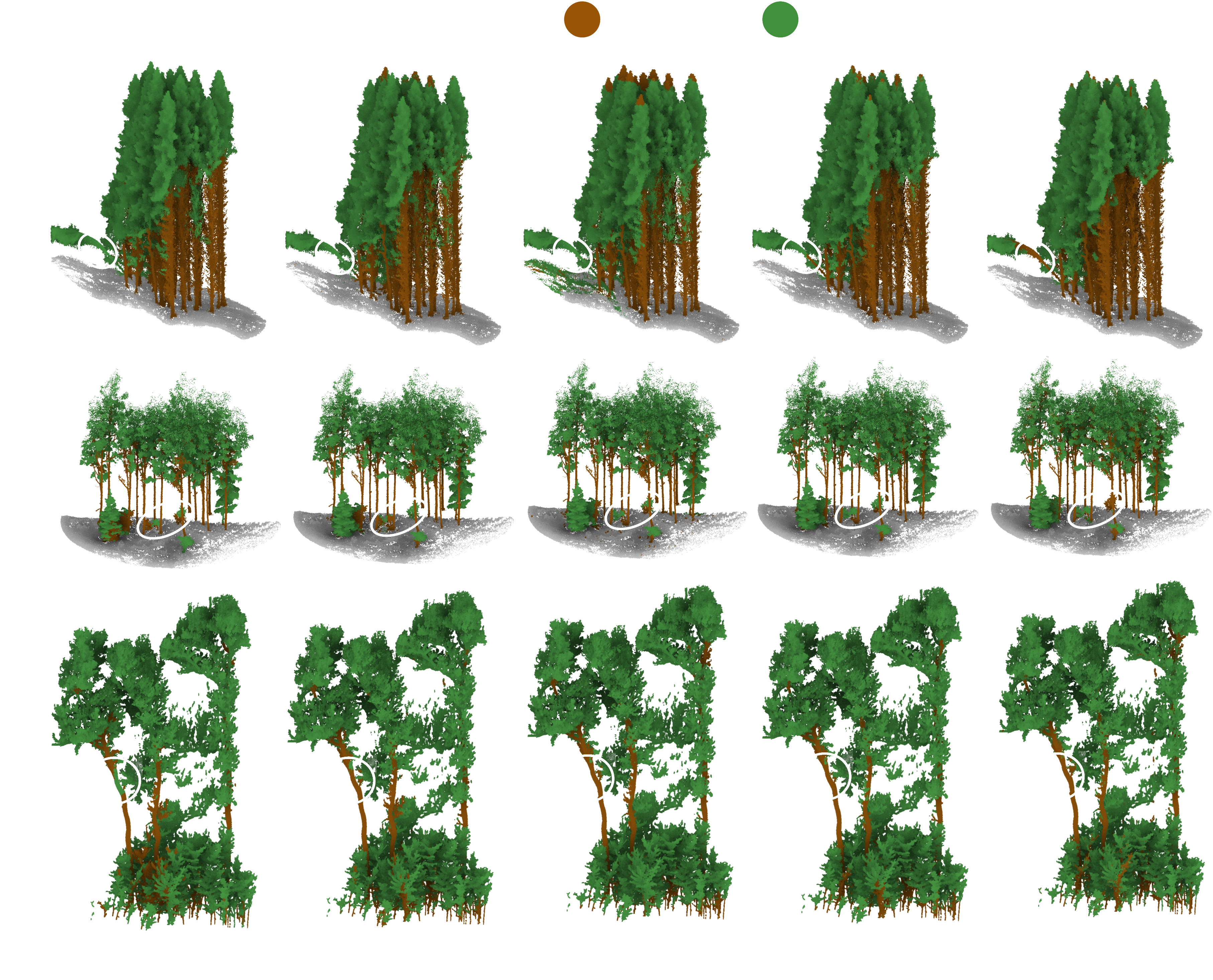
 Semantic Segmentation
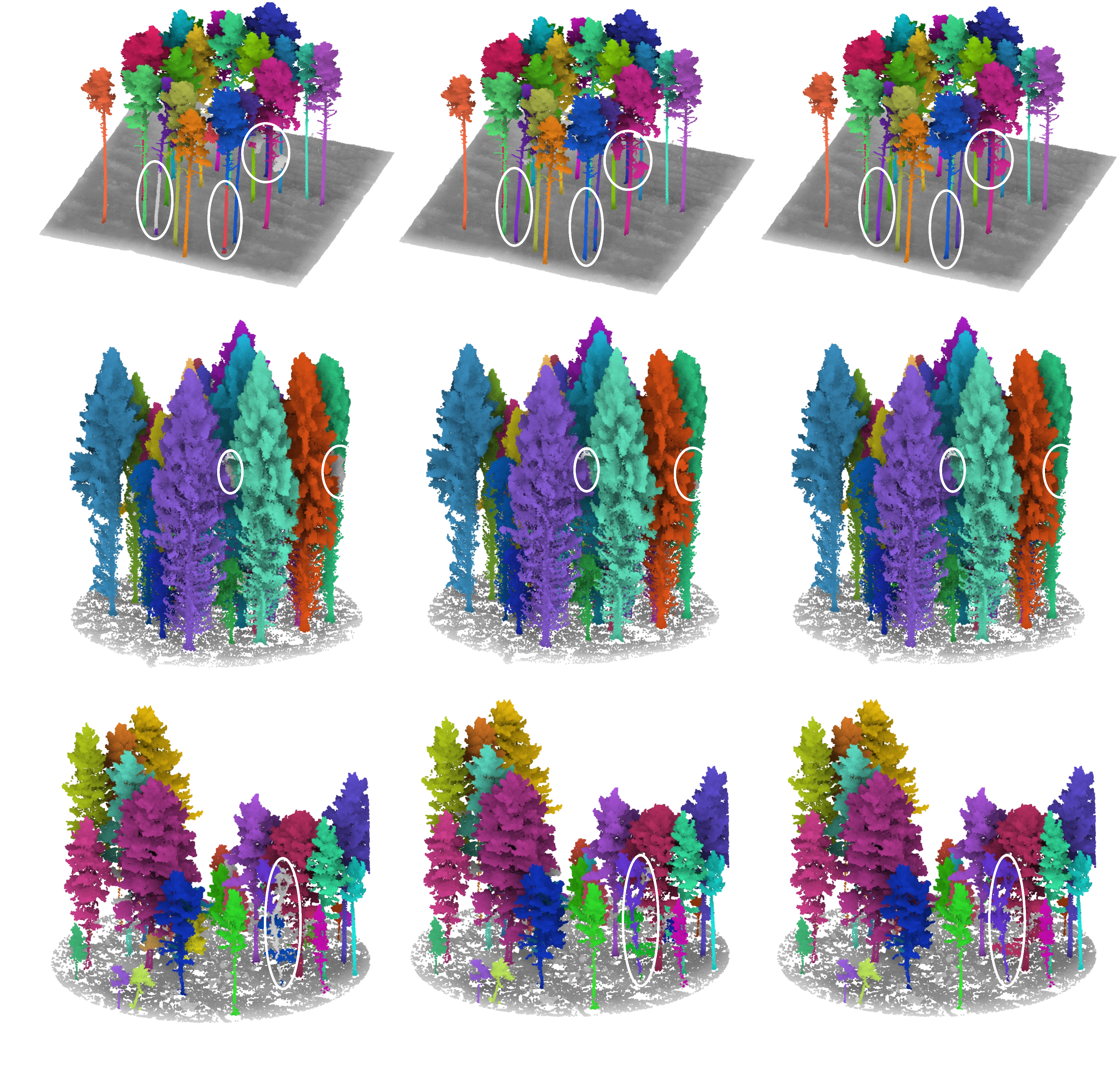
 Instance Segmentation
 Species Classification
 Age regression
We evaluate 3-class point-wise segmentation (ground / wood / leaf) on held-out forest plots, comparing a training-free kNN probe against linear probing, decoder probing, training from scratch, and full fine-tuning of the pretrained backbone.
We evaluate individual-tree instance segmentation and its auxiliary semantic segmentation on the FOR-instanceV2 benchmark.
| Individual tree seg. | Semantic seg. | ||||||||
|---|---|---|---|---|---|---|---|---|---|
| Method | mAP ↑ | mAP25 ↑ | mAP50 ↑ | F1 ↑ | Cov ↑ | Ground ↑ | Wood ↑ | Leaf ↑ | mIoU ↑ |
| ForAINetV2_R8 | 34.5 | 65.1 | 55.2 | 72.4 | 73.3 | 98.3 | 68.1 | 94.3 | 86.9 |
| ForAINetV2_R16 | 37.3 | 63.8 | 54.8 | 70.8 | 72.7 | 98.8 | 69.2 | 94.5 | 87.5 |
| TreeLearn | 19.6 | 41.4 | 30.9 | 50.3 | 52.5 | – | – | – | – |
| OneFormer3D | 48.7 | 71.8 | 65.7 | 73.1 | 80.0 | 97.8 | 63.1 | 93.4 | 84.8 |
| ForestFormer3D | 58.3 | 79.5 | 74.8 | 83.5 | 81.6 | 98.6 | 65.5 | 93.9 | 86.0 |
| ForestMamba | 54.9 | 77.7 | 72.0 | 82.0 | 76.6 | 98.5 | 65.4 | 93.9 | 85.9 |
| SegmentAnyTreeV2 | – | – | – | 83.4 | 89.6 | 99.1 | 70.5 | 93.9 | 87.8 |
| LitePT-scratch (ours) | 61.3 | 82.0 | 78.4 | 85.5 | 81.6 | 98.4 | 71.9 | 94.6 | 88.3 |
| ForPT-finetune (ours) | 60.6 | 81.4 | 77.6 | 84.7 | 81.1 | 98.5 | 71.4 | 94.4 | 88.1 |
We evaluate individual-tree species classification on the FOR-species20K benchmark (34 species).
| Method | Input | OA ↑ | Precision ↑ | Recall ↑ | F1 ↑ |
|---|---|---|---|---|---|
| SimpleView | Image | 76.2 | 76.9 | 75.5 | 75.6 |
| YOLOv5 | Image | 77.9 | 84.2 | 75.0 | 77.3 |
| DetailView | Image | 79.5 | 82.3 | 76.7 | 78.0 |
| PointAugment + DGCNN | Point cloud | 68.3 | 72.5 | 65.7 | 70.3 |
| PointMixer | Point cloud | 71.1 | 74.4 | 65.5 | 71.1 |
| MinkNet | Point cloud | 73.7 | 79.9 | 70.6 | 72.3 |
| Ensemble PointNet++ | Point cloud | 75.6 | 78.2 | 73.5 | 74.9 |
| LitePT-scratch (ours) | Point cloud | 82.7 | 85.3 | 81.6 | 82.5 |
| ForPT-linear probing (ours) | Point cloud | 68.7 | 74.2 | 66.0 | 67.8 |
| ForPT-finetune (ours) | Point cloud | 83.2 | 86.0 | 81.8 | 83.0 |
We evaluate individual-tree age regression on the FOR-age benchmark.
| Method | RMSE (years) ↓ | MD (years) → 0 | R² ↑ |
|---|---|---|---|
| Linear regression | 34.15 | -2.68 | 0.28 |
| PTv3-scratch | 22.80 | -3.96 | 0.68 |
| ForestFormer3D-finetune | 20.71 | 2.37 | 0.74 |
| LitePT-scratch (ours) | 20.41 | -0.55 | 0.74 |
| ForPT-linear probing (ours) | 30.65 | -1.10 | 0.42 |
| ForPT-finetune (ours) | 20.03 | 1.39 | 0.75 |
We probe frozen representations from four task-specific supervised pretrained backbones (semantic segmentation, instance segmentation, species classification, age regression) on every other downstream task, and compare them against our self-supervised (SSL) pretrained backbone under the same protocol.
| Target task (frozen probing) | |||||
|---|---|---|---|---|---|
| Sem. Seg.(mIoU ↑) |
Inst. Seg.*(mAP ↑) |
Species Cls.(allAcc ↑) |
Age Reg.(RMSE ↓) |
||
| Source (pretrained) model | SSL | 84.2 | 38.7 | 72.8 | 29.1 |
| Sem. Seg. | — | — | 68.8 | 30.9 | |
| Inst. Seg. | — | — | 70.1 | 30.6 | |
| Species Cls. | 82.2 | 22.4 | — | 30.8 | |
| Age Reg. | 79.5 | 24.6 | 70.9 | — | |
Semantic segmentation
Instance segmentation
Species classification
Age regression
Part of the compute is supported by the Swiss AI Initiative under projects a0182 and a144 on the Alps supercomputer. The project is supported by the Circular Bio-based Europe Joint Undertaking (CBE JU) and its members under Grant Agreement No 101157488 (SingleTree). This project is also funded by the EU Horizon Europe program under Grant Agreement No 101213369 (DVPS) and Grant Agreement No 101131841 (Embed2Scale). Additional funding for Embed2Scale has been provided by the Swiss State Secretariat for Education, Research and Innovation (SERI) and UK Research and Innovation (UKRI). Funded by the European Union. Views and opinions expressed are however those of the author(s) only and do not necessarily reflect those of the European Union or CBE JU. Neither the European Union nor the CBE JU can be held responsible for them.